Inflation Reduction Act Benefits for KC Homeowners: Top 2026 Savings
Delta T Heating & Cooling
Learn how to claim Inflation Reduction Act benefits for KC homeowners with HVAC tax credits up to $3,200.
Why Inflation Reduction Act Benefits for KC Homeowners Are Worth Paying Attention to Right Now
The inflation reduction act benefits for KC homeowners are real, significant, and still available in 2026 — but most people in the Kansas City metro have no idea what they actually qualify for or how to claim them. If your home is older, your energy bills are climbing, or your HVAC system is due for an upgrade, federal law may cover a meaningful chunk of what you'd otherwise pay out of pocket.
Here's a quick summary of what's available right now:
| Program | What It Covers | Max Benefit |
|---|---|---|
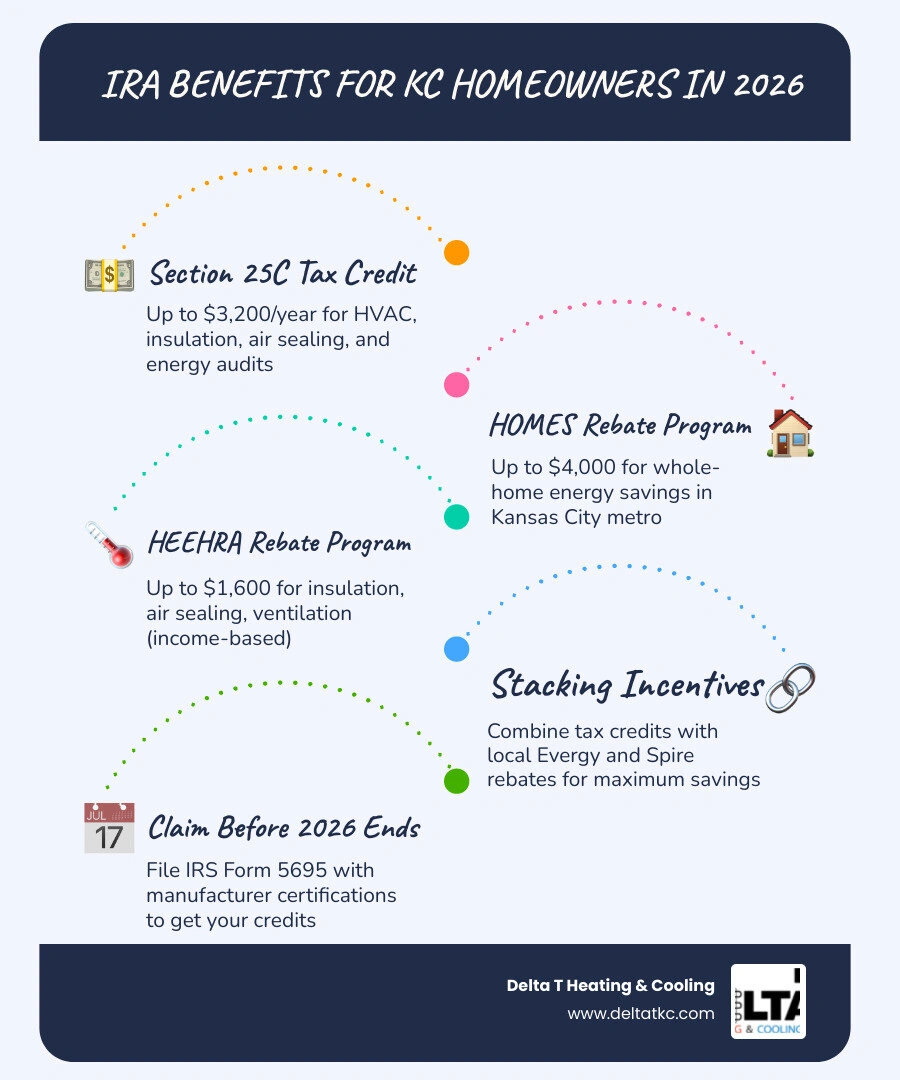
| Section 25C Tax Credit | HVAC, insulation, air sealing, energy audits | Up to $3,200/year |
| HOMES Rebate Program | Whole-home energy savings (modeled or measured) | Up to $4,000 |
| HEEHRA Rebate Program | Insulation, air sealing, ventilation (income-based) | Up to $1,600 |
These three programs can work together. A qualifying heat pump installation alone can earn you a $2,000 tax credit under Section 25C. Add insulation or air sealing and you can claim up to $1,200 more — all in the same tax year. Low-to-moderate income households earning under 150% of the Area Median Income may also qualify for point-of-sale rebates on top of those credits.
Kansas City sits in Climate Zone 4, which means your home faces real heating and cooling demands — hot, humid summers and cold winters. That makes energy efficiency upgrades both practical and financially smart, especially as electricity prices have risen faster than inflation across much of the country in recent years.
This guide breaks down exactly which upgrades qualify, how much you can save, how to claim the credits, and what local factors — including Kansas City's energy codes and utility rebate programs — mean for your specific situation.
Understanding the Inflation Reduction Act Benefits for KC Homeowners

When federal climate legislation rolled out under the Inflation Reduction Act (IRA), it represented the largest federal investment in domestic energy production and climate action in U.S. history. These programs are designed to put money back into the pockets of middle-class families while modernizing our regional housing stock.
However, navigating the financial mechanics of these benefits is key to maximizing your return. The first thing to understand is that the primary federal incentive—the Section 25C Energy Efficient Home Improvement Credit—is a non-refundable tax credit.
Unlike a point-of-sale discount or a cash refund, a non-refundable tax credit directly reduces your federal income tax liability. If you owe taxes at the end of the year, the credit wipes away what you owe dollar-for-dollar up to the limit of the credit. Because it is non-refundable, it cannot trigger a refund check for an amount larger than your total tax liability for that year, nor does it roll over to the next tax year.
This is where multi-year planning becomes an incredibly smart strategy for homeowners in Overland Park, Olathe, and Shawnee. Because the Section 25C tax credit limits reset every single calendar year on January 1st, you do not have to tackle every upgrade at once.
For example, you can strategically phase your home upgrades over multiple tax years:
- Year 1: Install a highly efficient heat pump to claim up to a $2,000 tax credit.
- Year 2: Upgrade your home's thermal envelope with new attic insulation and professional air sealing to claim up to an additional $1,200 tax credit.
- Year 3: Upgrade an old electrical panel or schedule a professional home energy audit to capture even more annual credits.
By spreading these projects across multiple years, you bypass the annual caps and maximize your total tax liability offsets.
Section 25C Tax Credits vs. State Rebate Programs
Understanding the difference between tax credits and state-administered rebates is crucial for planning your budget. The table below outlines how these programs differ in application, eligibility, and administration:
| Feature | Section 25C Tax Credit | HOMES Rebate Program | HEEHRA Rebate Program |
|---|---|---|---|
| Incentive Type | Federal Tax Credit | State-Administered Rebate | State-Administered Rebate |
| How It's Claimed | Filed with annual federal taxes | Applied for post-purchase | Applied at point-of-sale |
| Income Limits | None (open to all taxpayers) | None (higher incentives for low-income) | Low-to-moderate income (<150% AMI) |
| Maximum Limit | Up to $3,200 annually | Up to $4,000 (standard) / $8,000 (low-income) | Up to $1,600 for insulation/air sealing |
| Primary Focus | HVAC, insulation, audits, panels | Whole-home energy reduction | Electrification & insulation |
While the federal 25C tax credit is managed directly by the IRS, the HOMES (Home Owner Managing Energy Savings) and HEEHRA (High-Efficiency Electric Home Rebate Program) rebates are funded federally but administered locally by state energy offices.
For residents in Kansas City, Missouri, and surrounding areas, this means programs are managed by the Missouri Department of Natural Resources. On the Kansas side, the Kansas Corporation Commission oversees similar state-specific rollouts.
Section 25C Energy Efficient Home Improvement Credit
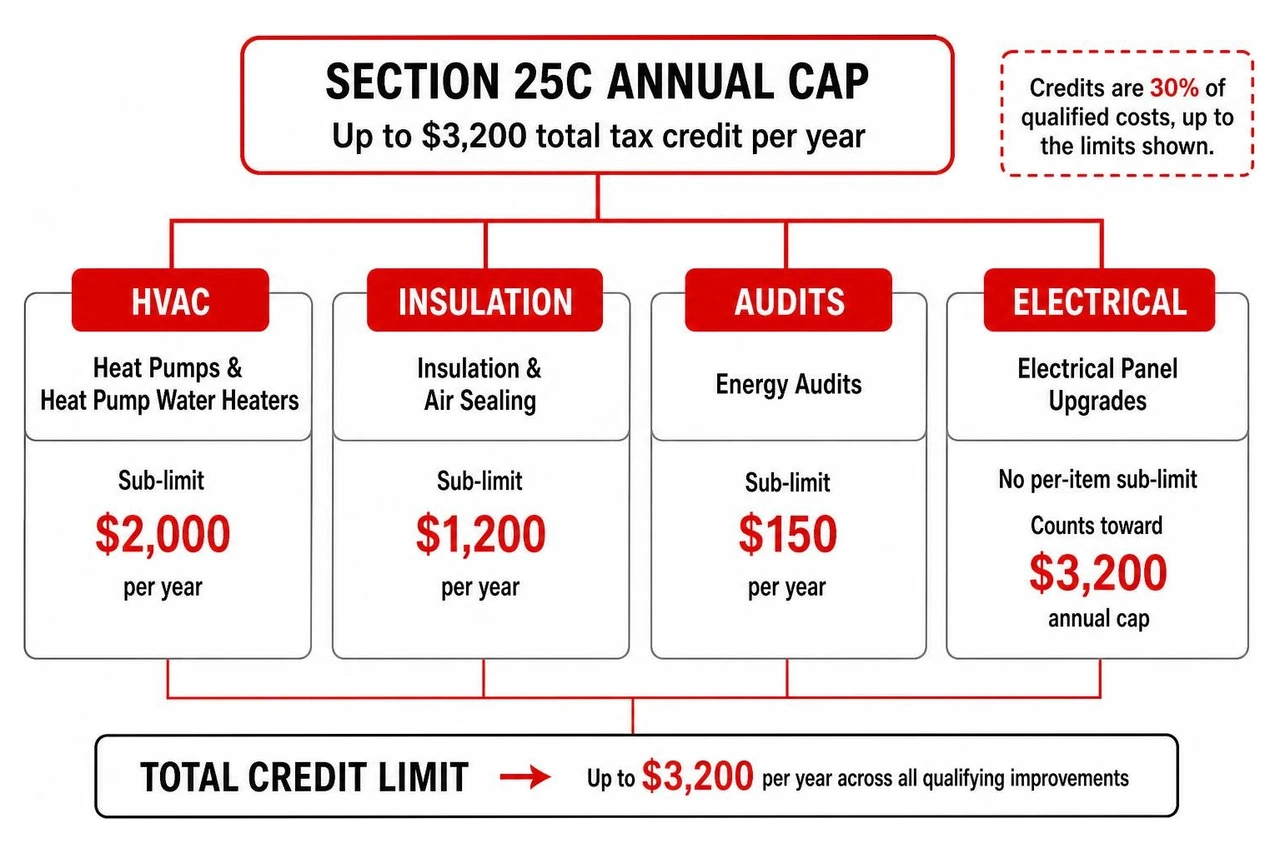
The Section 25C credit is the workhorse of the IRA's residential incentives. It allows you to claim 30% of the cost of qualifying energy-efficiency improvements, up to an annual cap of $3,200. Within that overall cap, specific sub-limits apply:
- Heat Pumps and Heat Pump Water Heaters: 30% of the cost, up to a maximum of $2,000 per year. Because heat pumps provide both central heating and air conditioning, they are the single most impactful upgrade you can make to lower your bills.
- Insulation and Air Sealing: 30% of the cost, up to a maximum of $1,200 per year. This includes blowing insulation into your attic, sealing drafty crawl spaces, and sealing wall cavities.
- Energy Audits: 30% of the cost, up to a maximum of $150 for a professional home energy assessment.
How to Claim Inflation Reduction Act Benefits for KC Homeowners
To successfully secure your tax credits at the end of the year, you must follow a structured claiming process.
First, ensure you receive a Manufacturer's Certification Statement from us for any qualifying HVAC system we install. This document is a signed statement from the manufacturer certifying that the specific model meets or exceeds the efficiency standards required by the IRS.
When tax season arrives, you or your tax professional will fill out IRS Form 5695 (Residential Energy Credits) and submit it alongside your standard federal tax return. This form calculates your total qualifying expenses and applies the 30% credit against the taxes you owe.
While some DIY insulation projects can qualify for the 25C tax credit if you keep perfect material receipts, professional installation is almost always required for state-administered rebates. State offices require detailed documentation, post-installation verification, and sometimes pre- and post-upgrade energy modeling to prove actual performance improvements. Working with a professional team ensures your upgrades are compliant and your paperwork is audit-ready.
Qualifying HVAC and Insulation Upgrades for Kansas City Homes
Kansas City lies squarely in Climate Zone 4. This means our local homes experience extreme seasonal swings—bitterly cold winters and sweltering, humid summers. Because of this, local building science and energy codes emphasize high-performance thermal envelopes.
Proper insulation and air sealing are the most cost-effective ways to reduce the workload on your heating and cooling equipment.
To qualify for the maximum incentives, your upgrades must meet strict efficiency thresholds:
- Heat Pumps: Must meet the Consortium for Energy Efficiency (CEE) highest non-advanced tier. For central split-system heat pumps, this generally requires meeting or exceeding SEER2 ratings of 16 and high heating efficiency standards.
- Insulation: Must meet the prescriptive standards of the International Energy Conservation Code (IECC). This includes upgrading attic insulation (often aiming for R-49 to R-60 values) and ensuring proper wall insulation and comprehensive air sealing of the home's drafty bypasses.
Upgrading to modern heat pump technology is especially beneficial in our region because today's cold-climate heat pumps can extract heat from the outdoor air even when temperatures drop below freezing, eliminating the need to rely solely on expensive backup heat.
Income Eligibility for Inflation Reduction Act Benefits for KC Homeowners
While the Section 25C tax credit is available to all taxpayers regardless of income, the HEEHRA (High-Efficiency Electric Home Rebate Program) program is strictly income-qualified. Eligibility is tied directly to the Area Median Income (AMI) of your specific county in the Kansas City metro area.
- Low-Income Households (Under 80% of AMI): Eligible for 100% of the cost of qualifying electrification projects to be covered, up to a maximum of $14,000. This includes up to $1,600 specifically for insulation, air sealing, and ventilation.
- Moderate-Income Households (80% to 150% of AMI): Eligible for 50% of the cost of qualifying projects to be covered, up to the same program caps.
- Above 150% of AMI: Not eligible for HEEHRA point-of-sale rebates, but fully eligible for the Section 25C tax credits and the performance-based HOMES rebates.
Local Energy Code Impact on Efficiency Standards
Local building codes play a massive role in how much energy your home consumes. In recent years, the Kansas City, Missouri City Council adopted the progressive 2021 IECC energy codes but subsequently passed local amendments that rolled back some of these requirements—such as lowering wall insulation standards from R-30 to R-19 and loosening duct testing rules.
These regulatory rollbacks mean that newly constructed or standard tract homes in the area may not be built to the highest efficiency standards. Consequently, the financial burden of energy waste is shifted directly to the homeowner.
By utilizing federal IRA incentives to insulate your attic, seal your ductwork, and install a high-efficiency heat pump, you can bypass these local code compromises. Aiming for a lower HERS (Home Energy Rating System) Index score—the industry standard where a lower number represents a more efficient home—directly protects your wallet from rising utility rates, regardless of municipal code changes.
Frequently Asked Questions
Can I combine federal tax credits with local utility rebates in Kansas City?
Yes! "Stacking" incentives is one of the best ways to reduce the cost of an HVAC upgrade. You can combine the federal Section 25C tax credit with local utility rebates offered by Evergy or Spire.
For instance, if we install a qualifying heat pump in your Lenexa or Overland Park home, you can claim the 30% federal tax credit (up to $2,000) on your taxes, and we can help you apply for immediate cash-back rebates directly through Evergy's heating and cooling incentive programs.
Do I need a professional energy audit to qualify for these tax credits?
You do not need a professional energy audit to claim the Section 25C tax credit for installing a heat pump or adding insulation. However, scheduling a professional energy audit is highly recommended.
Under Section 25C, you can receive a 30% tax credit (up to $150) to offset the cost of a professional home energy assessment. An audit establishes a baseline of your home's energy use, pinpoints exactly where air is leaking, and helps us prioritize upgrades so you get the maximum comfort and savings for your investment.
Are these incentives still available under the current administration in 2026?
Yes. As of July 2026, the Section 25C federal tax credits remain fully active and are locked in by federal law through 2032. While there are ongoing policy debates at the federal level regarding the freezing or redirection of certain unspent state-administered rebate funds, the core tax credits you claim on your annual tax returns are secure.
Because of potential future legislative shifts, acting sooner rather than later is the safest way to guarantee you lock in these historic savings.
Conclusion
Upgrading your home's heating, cooling, and insulation is no longer just about staying comfortable during a brutal Midwest winter or a humid July heatwave—it is a strategic financial decision. By leveraging the inflation reduction act benefits for KC homeowners, you can modernize your home, permanently lower your monthly energy bills, and let federal tax credits cover a significant portion of the work.
At Delta T Heating & Cooling, we provide prompt, honest, and professional HVAC installation, maintenance, and repair services across Johnson County and the wider Kansas City metro. Whether you are in Olathe, Shawnee, Overland Park, or Lee's Summit, our team will help you select qualifying high-efficiency equipment, provide the exact manufacturer certifications you need for your taxes, and ensure your system is perfectly sized for Climate Zone 4.
Don't leave federal money on the table. Schedule your energy-saving HVAC upgrade today and let us help you maximize your comfort and your tax savings!
Talk to us
Need Help?
Engineer-led diagnosis. Upfront pricing. Free second opinions on outside quotes.
More Articles
View All PostsReady to Get Started?
Whether you need a repair, maintenance, or a new installation, our expert team is here to help.